The question we hear most from guests planning South Africa is not about animals. It is about choice. We currently list more than 120 lodges across the Greater Kruger and the Sabi Sand (often written Sabi Sands), priced from under ZAR 4,000 to more than ZAR 56,000 per person per night. Almost every one of them sits in Big Five leopard country. From the outside it looks like one product sold at 120 different prices.
We have been planning safaris here since 2006, for more than 60,500 travellers, and were named Africa's Leading Safari Company at the World Travel Awards in 2024, 2025 and 2026. Over those twenty years the answer to “which lodge?” has settled into a method, and it does not start with the lodge.
This is how that starting point usually sounds, in a guest’s own words:
“There were so many choices of safari lodges to choose, and so we decided to get help from Safari.com. Shann was assigned to assist us, and was super responsive. She understood our requirements and found a lodge that met our needs”
Why every lodge looks the same
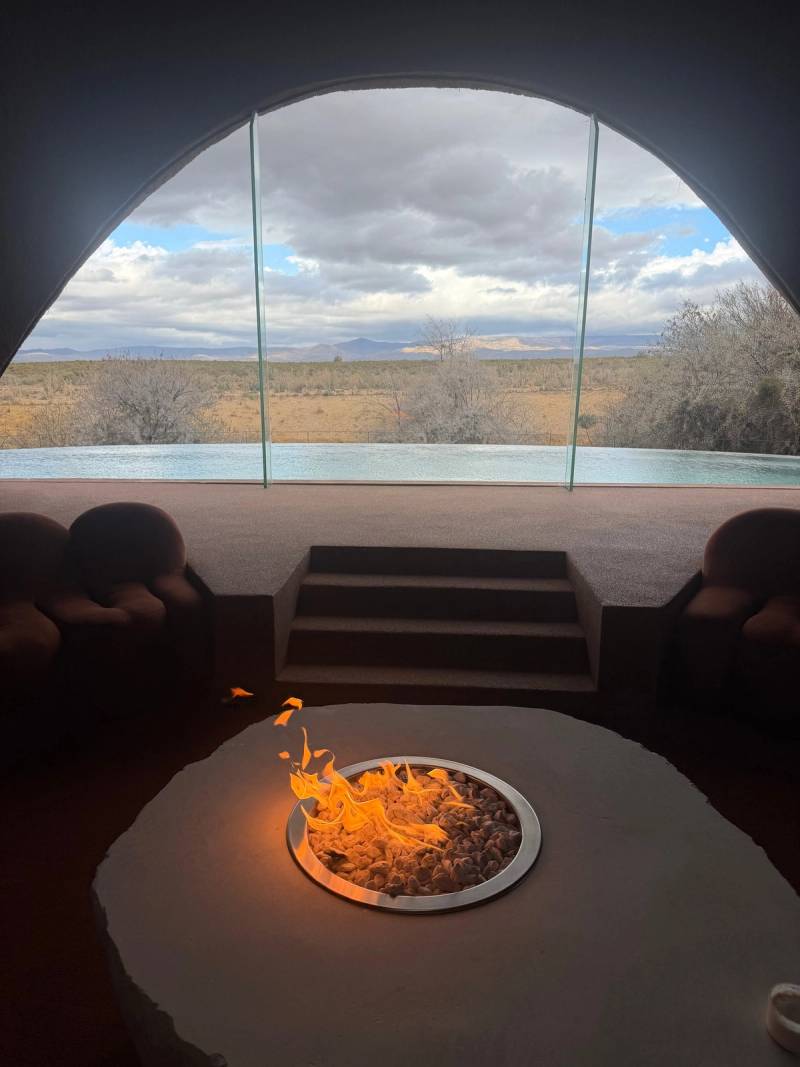
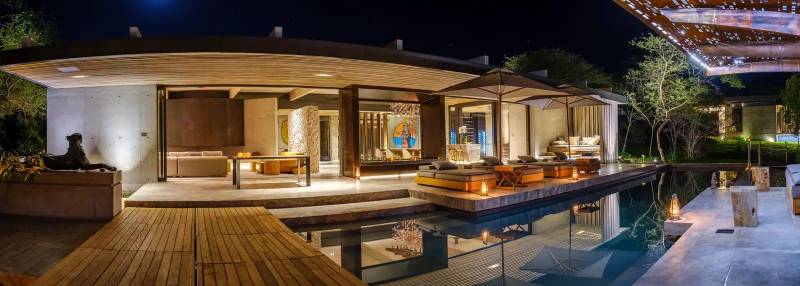
Put four lodges side by side and the problem is obvious. A thatched deck, a plunge pool, a view over the bush. The four below sit on two reserves and span a fourfold difference in price, and you would struggle to rank them from the photographs.
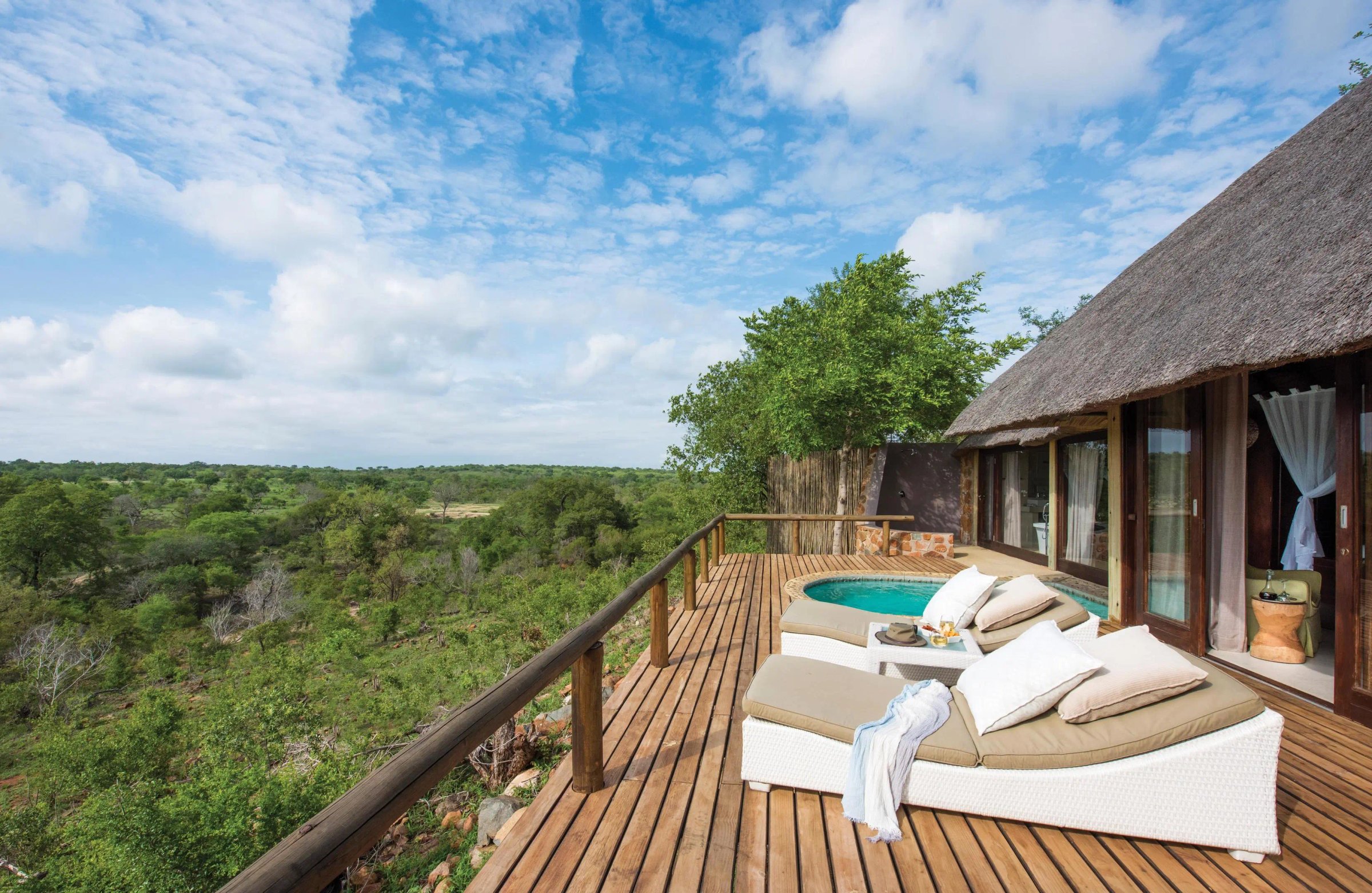
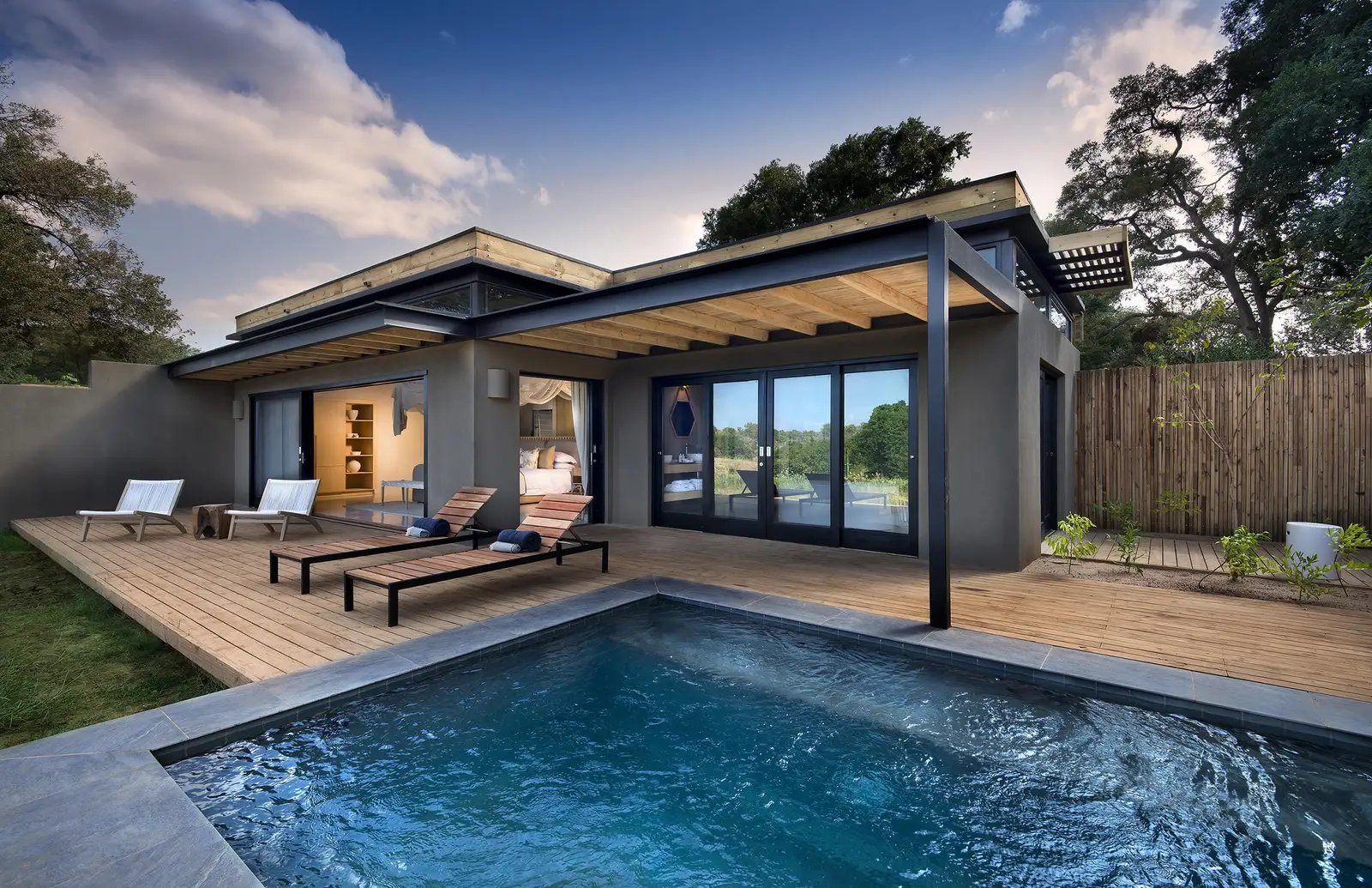
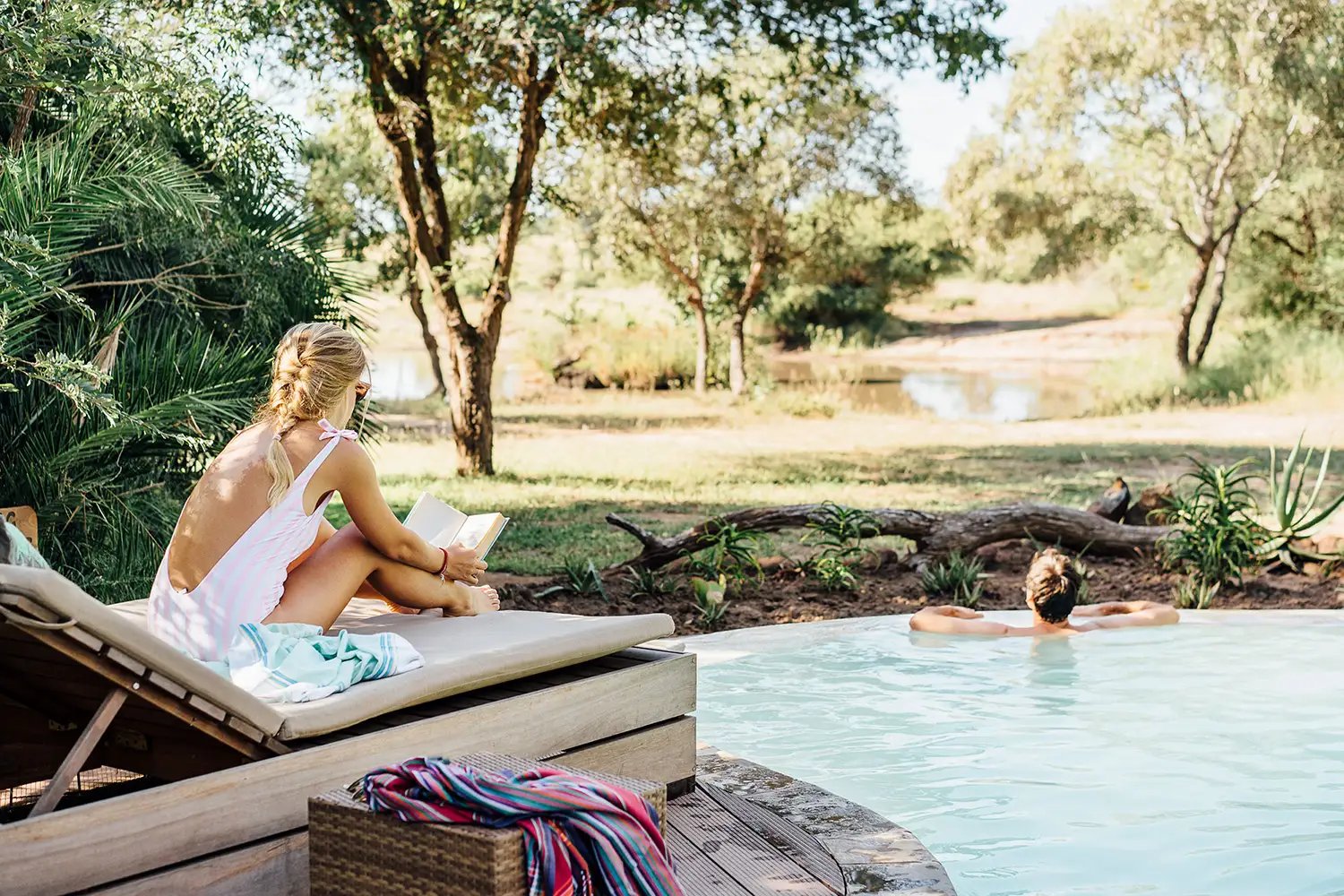
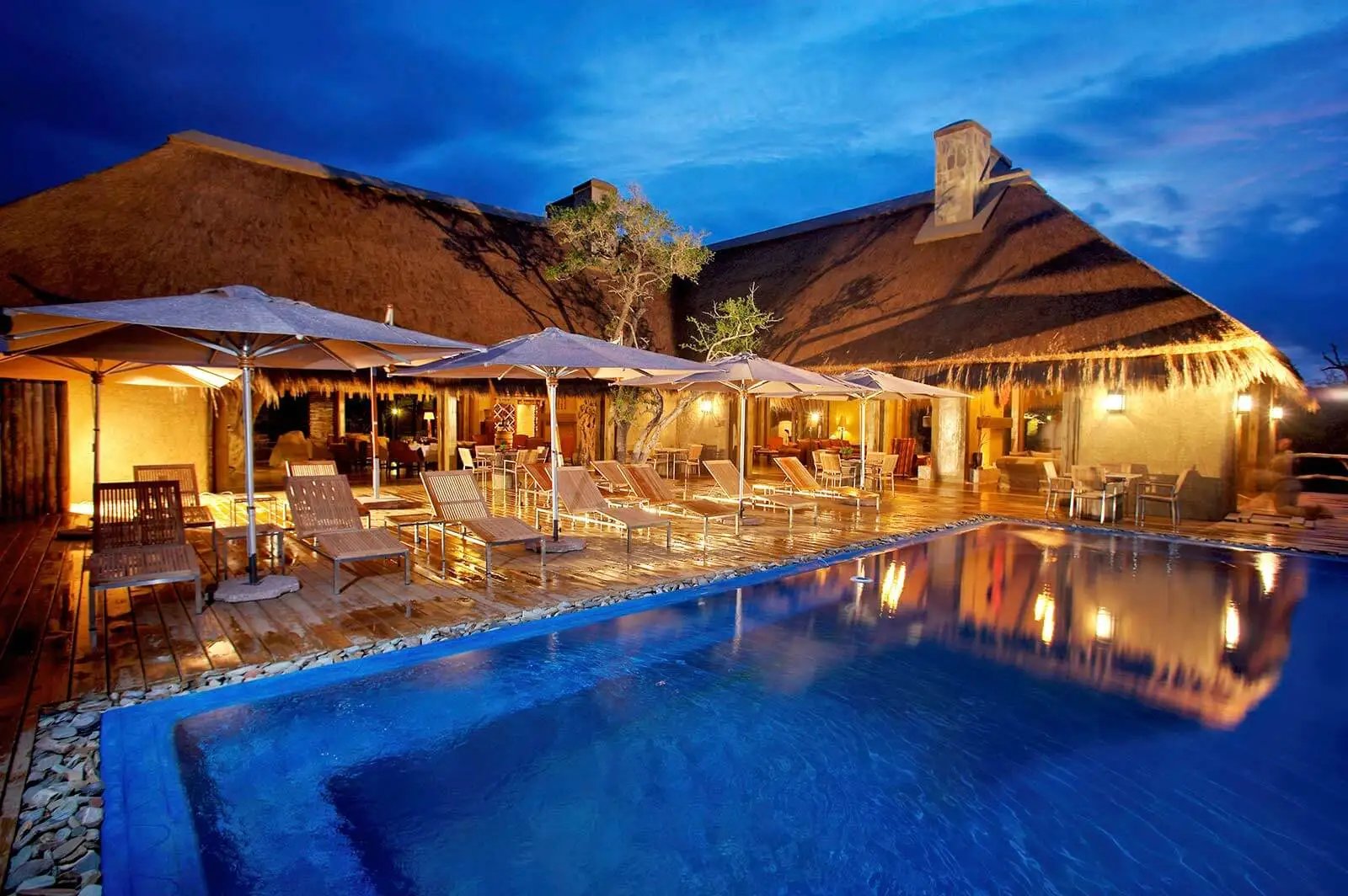
Beautiful lodges are the one thing this region has in oversupply. What varies is the ground under the lodge: how close it sits to permanent water, whether it touches the Kruger boundary, how much land its vehicles can drive, and how many other vehicles share that land. None of that shows in a pool photograph, and it is what you are actually paying for.
The order of decisions
Most travellers plan a safari backwards. They shortlist the lodges they like the look of, then try to compare them. We work the other way round, because three things decide what you see on a game drive, and all three are settled before the lodge comes into it.
| What matters | Why it matters | Fixed by |
|---|---|---|
| The rules | Whether your guide may leave the road to follow an animal, drive after dark, and how many vehicles may share a sighting. | Ecosystem: the park, or the private reserves |
| Environment and wildlife | Where the land sits against the Kruger boundary and the permanent rivers decides what lives on it, how densely, and how consistently through the year. | Location: reserve and sector |
| Contention | How many other lodges have traversing agreements over the land you drive decides how many vehicles compete for each sighting. | Reserve and block |
| The hours between drives | Size, family policy, vehicle seating, style and price. | Lodge |
-
Sets the rules: road-bound viewing in the park, or off-road, at night and capped on private land.First Ecosystem
-
Sets the broad location against the park, and the traversing agreements that decide how many lodges share the land.Second Reserve
-
In the Sabi Sand, sets the location against the rivers and the park, block by block.Third Sector
-
Decides the hours between drives: size, family policy, style and price.Last Lodge
The order matters because each step locks in something no later step can change. A lodge on a public road in Kruger cannot follow a leopard off the tarmac, however good its guides are. A lodge cannot add a river its land does not have, and it cannot cancel the traversing agreements its neighbours hold over the same ground.
The lodge comes last because, on any one piece of ground, the lodges are close substitutes. Neighbouring lodges drive the same land and follow the same animals. What separates them is what happens between drives, and that matters, but it is the smallest of the differences. By the time you reach this step, the shortlist is a handful of properties, not 120.
Step one: the park or the private reserves
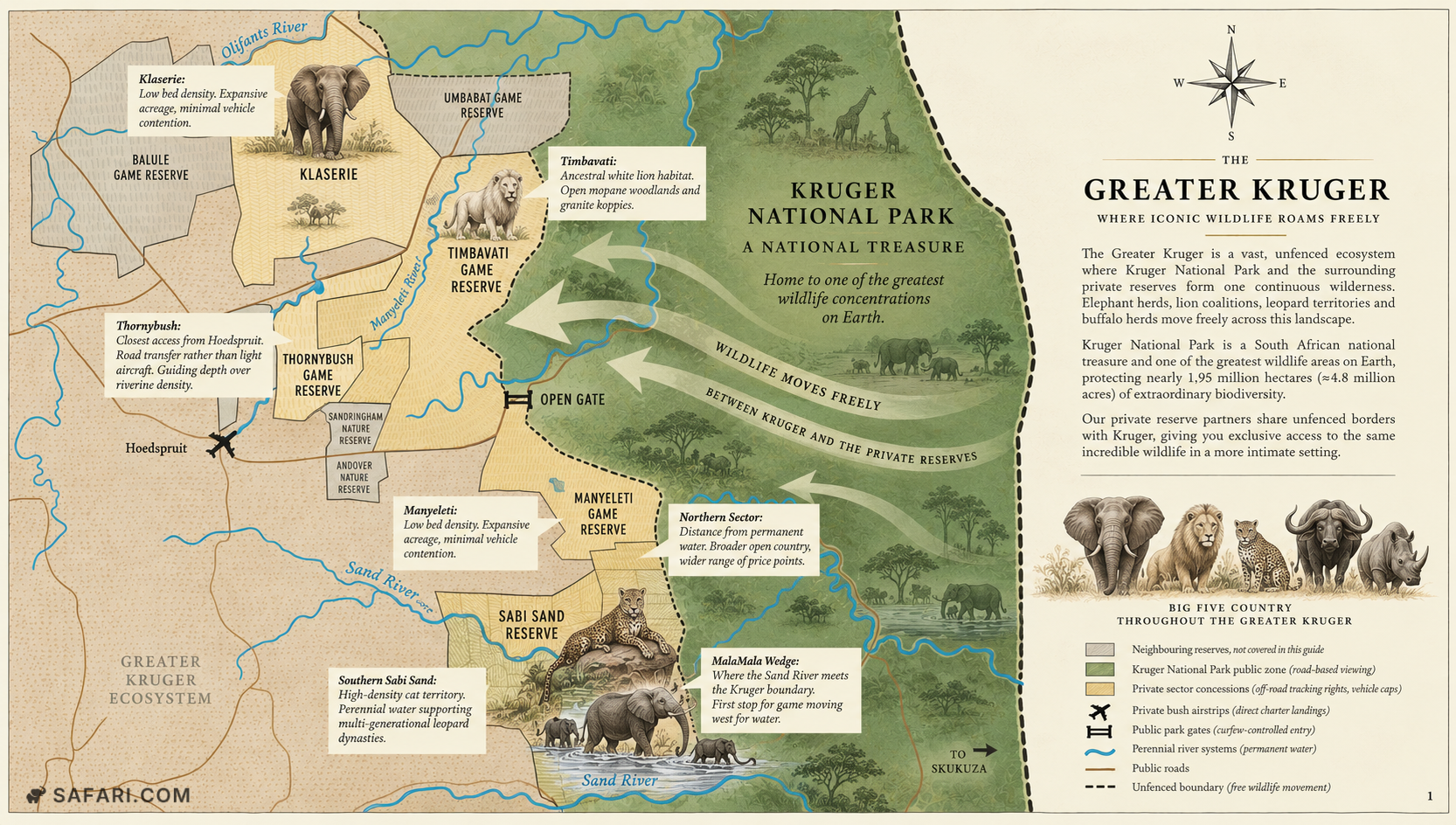
Kruger National Park covers 4.8 million acres (1.9 million hectares). Inside the park, game viewing happens from public roads, within gate hours, and there is no limit on how many cars gather at a sighting. A leopard in a tree near a main road can draw dozens of self-drive vehicles.
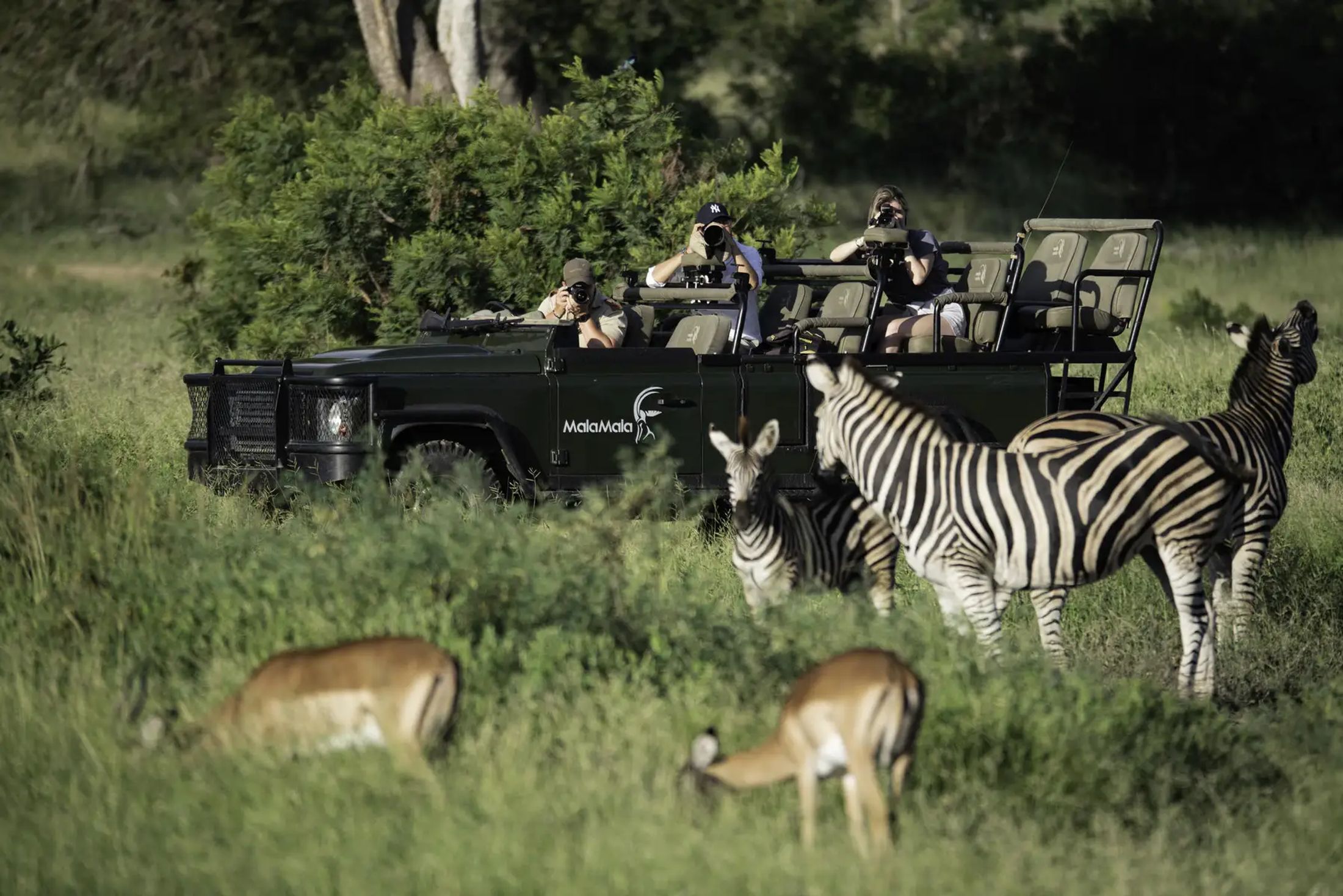
Along the park’s western edge lie the private reserves. The fences between them and Kruger came down decades ago, so elephant herds, lion prides and leopard territories move across the whole system as they did before the fences went up. What changes on private land is the rules. Guides drive off-road to follow an animal, run spotlit night drives, and cap the number of vehicles at each sighting.
| Ground | Vehicles at a sighting | What it means on the ground |
|---|---|---|
| Kruger public roads | No limit | Road-bound viewing within gate hours. No off-road driving. |
| Private concessions inside Kruger | Typically two to three | Private-reserve rules on exclusive ground inside the park. |
| Sabi Sand and MalaMala | Typically two to three | Off-road tracking and spotlit night drives. |
| Timbavati, Klaserie, Manyeleti | Typically two, often fewer | Large concessions, few beds, little contact with other vehicles. |
There is a middle path for guests who want Kruger by name. A small number of private concessions inside the park run on private-reserve rules. Singita Lebombo Lodge has 15 suites above the N’wanetsi River on a 33,000-acre concession in the far east of the park, from ZAR 56,310 pps/night. Hoyo Hoyo Safari Lodge has six suites on a 24,700-acre (10,000-hectare) concession where vehicles may leave the road, from ZAR 10,490 pps/night.
More vehicles are not simply worse, either. More vehicles on a traverse means more eyes and more sightings found over the radio. The cost is time at each sighting, and the right balance depends on what you want from a drive.
Step two: choose the ground
The private reserves fall into four landscapes, and each one is best at something different.
The riverine Sabi Sand and MalaMala
The Sand River runs through the middle of the Sabi Sand and the Sabie runs along its southern edge. Permanent water means permanent prey, and permanent prey means resident female leopards holding overlapping territories across generations. This is the densest leopard country in southern Africa, and it is priced accordingly. MalaMala sits where the Sand River meets the Kruger boundary, the first stop for game moving west in search of water in the dry months.
Lodges with river frontage include Lion Sands River Lodge on the Sabie, from ZAR 28,570 pps/night; Dulini River Lodge, six suites under ebony trees on the Sand River, from ZAR 34,500 pps/night; Londolozi Varty Camp, from ZAR 27,950 pps/night; and MalaMala Camp, where game drives are limited to six guests per vehicle, from ZAR 27,600 pps/night.
The northern Sabi Sand
Further from the rivers, the northern blocks open into broader country. Game viewing is still excellent and waterholes concentrate animals reliably, but the year-round riverine cat density of the south is not replicated here. The trade is value: this is where most of the reserve’s more approachable prices sit. Elephant Plains Game Lodge is from ZAR 7,300 pps/night. Arathusa Safari Lodge, which overlooks a large waterhole, is from ZAR 11,500 pps/night.
Timbavati, Klaserie and Manyeleti
The northern reserves share a long unfenced boundary with the Orpen and Satara side of the park, Kruger’s lion heartland. Concessions are vast, lodges are few and far apart, and vehicle pressure is the lowest we see anywhere in the system. This is also walking country. Timbavati is crossed by the dry Nhlaralumi riverbed, a patrol route for lion through the summer months.
Tanda Tula Safari Camp overlooks the Nhlaralumi, from ZAR 31,500 pps/night. Kings Camp, also in the Timbavati, has about 24,700 acres (100 km²) of traversing, from ZAR 18,500 pps/night. In the Klaserie, Klaserie Drift looks over the Klaserie River with 27,200 acres (11,000 hectares) of traverse, from ZAR 13,750 pps/night, and Africa on Foot is built around walking safaris, from ZAR 6,320 pps/night. In Manyeleti, Tintswalo Safari Lodge has seven suites on a seasonal river, from ZAR 23,950 pps/night.
“Lindi Weeks has been assisting us in planning a 4 day safari in the Klaserie Game Reserve. She has been so amazing, assisting us so beautifully with all the decisions to be made.”
Thornybush
Thornybush is the closest private reserve to Hoedspruit’s airport, so most guests arrive by road rather than light aircraft: no second flight and no soft-bag luggage limit. It has no park frontage and no perennial river, and trades riverine density for access and guiding depth. For families with young children, nervous flyers, or a short Kruger leg in a longer trip, that simplicity is worth more than it sounds. Thornybush Game Lodge is from ZAR 19,800 pps/night, and Royal Malewane, at the top of the reserve’s range, from ZAR 56,500 pps/night.
Inside the Sabi Sand: water, position, traversing
The Sabi Sand is not one reserve so much as a mosaic of independently owned blocks, most with several lodges on them. Some blocks sit on the Sand River. Some lie on the Kruger boundary. Some share traversing with their neighbours and some do not. Those differences shape a stay as much as the lodge does, so we weigh them in this order.
-
Sand River frontage and access to permanent water.First Water
-
Proximity to the Kruger boundary and the game that moves out of it.Second Position
-
How much connected land your vehicle can actually drive.Third Traversing
-
Rooms, style, service and price.Only then The lodge
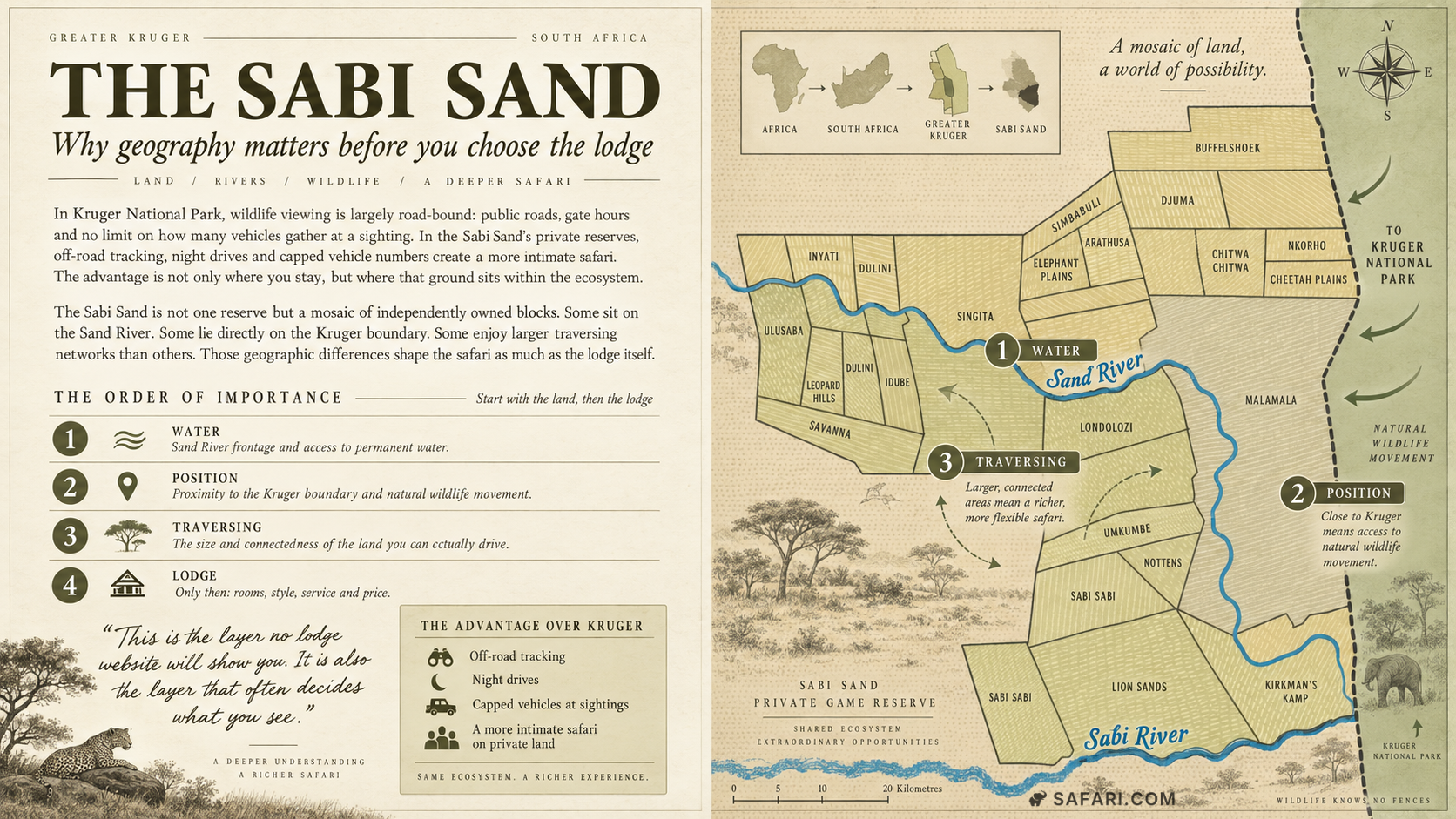
Water outranks the boundary for a reason. The western blocks have no park frontage, but they hold the Sand River, and through the dry months from May to October the river is what holds the leopards.
Dulini River Lodge shows how this plays out. It sits on the Sand River in the western Sabi Sand, with no park frontage, and its six suites are from ZAR 34,500 pps/night: river-sector pricing on a block that never touches the Kruger boundary. Traversing then separates the blocks that share their neighbours’ land from the ones that drive their own, and that is a question for us rather than a lodge website. Our job at this stage is to narrow the field, not to make the decision for you.
“We were between safari lodges and she really sold us on Dulini with her chill and approachable attitude. She gave us more than enough information while letting us feel like the decision was ours and was flexible to providing multiple options.”
Step three: only then, the lodge
Once the ground is chosen, the shortlist is usually a handful of properties, and the questions become practical.
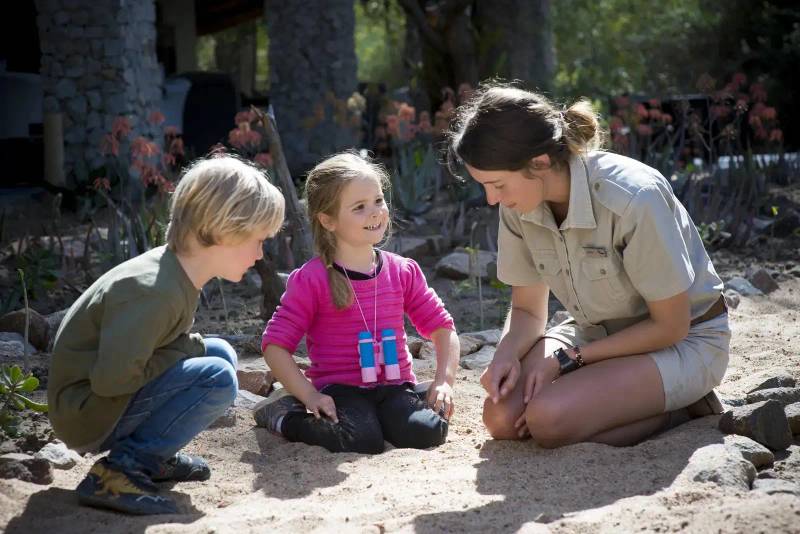
The first is who is travelling. Child policies vary more than guests expect, even within one reserve. MalaMala Camp welcomes children of all ages, while MalaMala Rattray’s Camp, from ZAR 42,800 pps/night, takes no children under 16 unless the camp is booked exclusively. Leopard Hills draws the line at ten and Arathusa at twelve, both with exceptions for exclusive bookings. Thornybush Game Lodge welcomes all ages but takes no under-sixes on game drives, and runs a Ranger in Training programme for children.
The second is who you share a vehicle with. Most lodges seat six guests to a vehicle. Private vehicles are usually a paid upgrade and depend on availability, as at Tanda Tula, so they are worth requesting early for photographers and families.
The third is size. Dulini River Lodge has six suites, Leopard Hills eight glass-fronted suites on a rise in the western Sabi Sand, from ZAR 26,300 pps/night, and Thornybush Game Lodge eighteen plus two family suites. A small camp changes the feel of meals and drives more than the décor does. One guest from Germany, after a stay we planned:
“Leopard Hills are indeed the boutique luxury camp that you recommended. People there are incredible friendly and knowledgable. The guide was excellent.”
Style and price come last. They are the questions most guests start with, and the easiest to answer once everything above is settled.
Where to point yourself
| If your priority is | Start with |
|---|---|
| Leopard, above everything | The riverine southern Sabi Sand |
| Game straight out of the park | MalaMala for river crossings, Timbavati for lion |
| Space and solitude | Klaserie or Manyeleti |
| Walking safaris | Timbavati and the Klaserie |
| Kruger itself, by name | A private concession inside the park |
| Photography | The riverine south, with a private vehicle |
| Travelling with young children | Thornybush, or a lodge with a children’s programme. Policies vary widely. |
| Best value | The northern Sabi Sand, or Thornybush |
| A first safari of about a week | A split stay: the riverine south, then a northern reserve |
The table points at ground rather than lodges because on any one piece of ground, which property suits you depends on who is travelling, how you like your days to run and what the trip is for.
The case for a split stay
No single reserve does everything best. The riverine south has leopard density. The north has space, walking and lion country. Thornybush has access. MalaMala has the river where it leaves the park. So the best answer is often not a choice between them at all.
The classic Greater Kruger itinerary pairs ground rather than picking it: three or four nights in the riverine southern Sabi Sand for leopard and close-range tracking, then three or four nights in a northern reserve for open country, walking and lion. The reserves are a short flight or drive apart, and each half sharpens the other.
Talk it through with a specialist
This is the conversation our safari specialists have every day, and it usually takes about twenty minutes. Tell us who is travelling, when, and what the trip is for, and we will come back with a short list built on the ground first. Get in touch and we reply in as little as 15 minutes during working hours.
“Dolan quickly assembled two incredible options in Sabi Sands and Victoria Falls for us to consider. He responded to emails so quickly we wondered if he ever slept! Planning a safari can be daunting and Dolan made the process stress free.”
Written by Safari.com Editorial