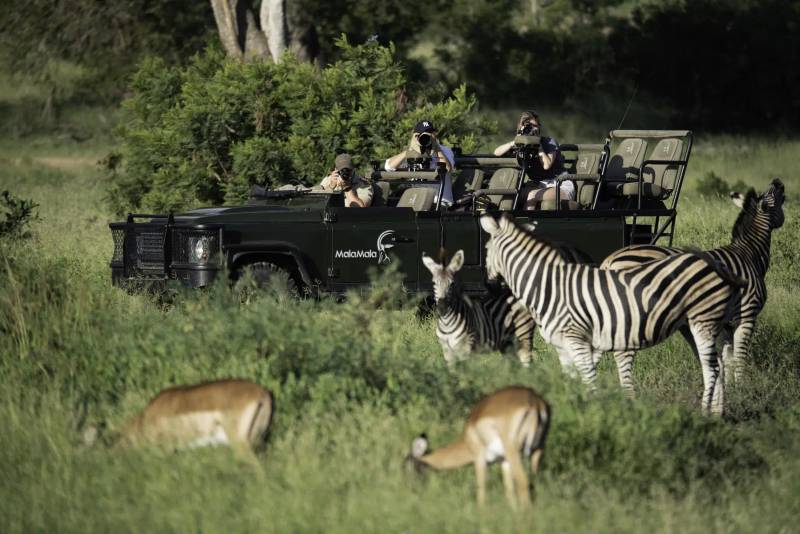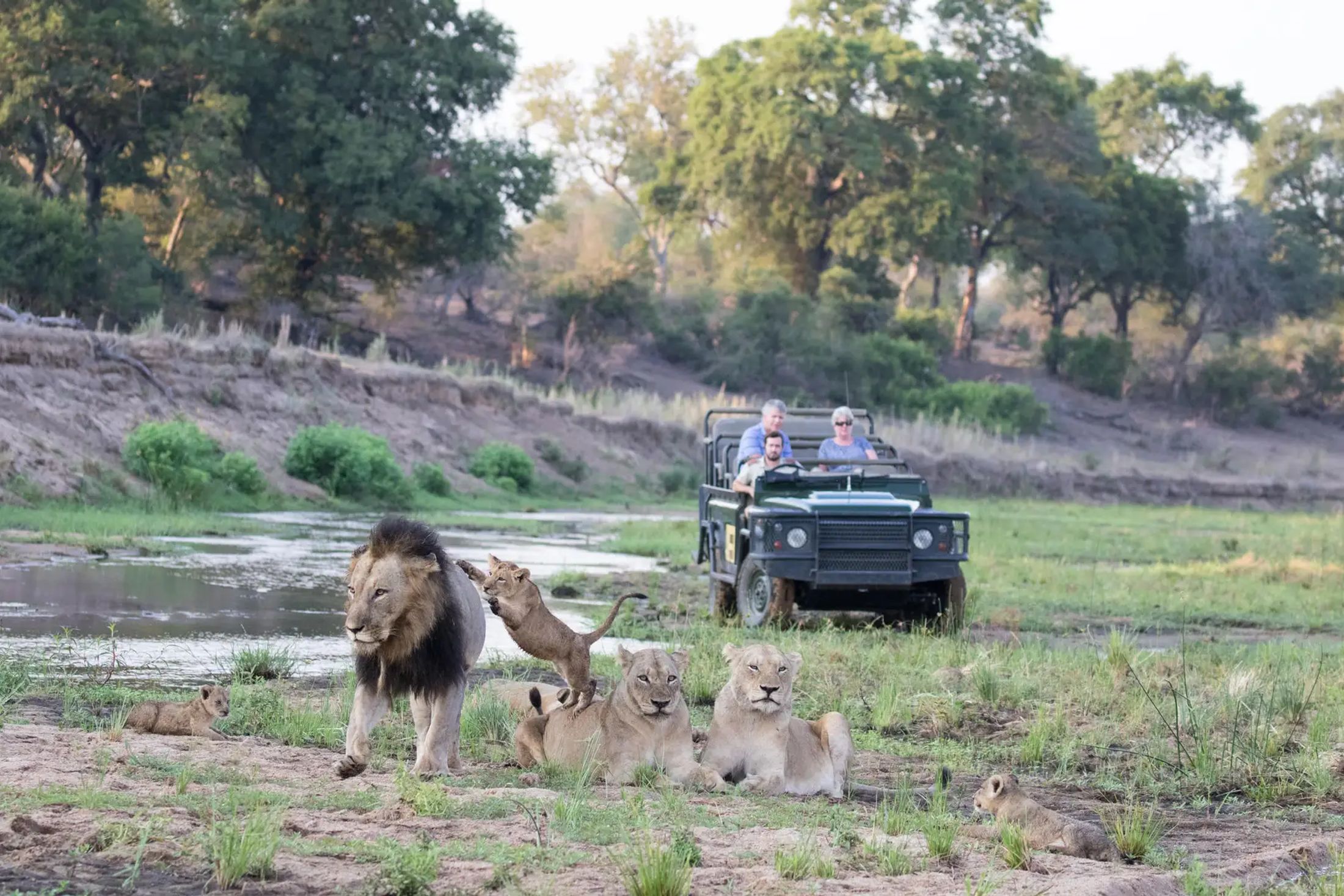
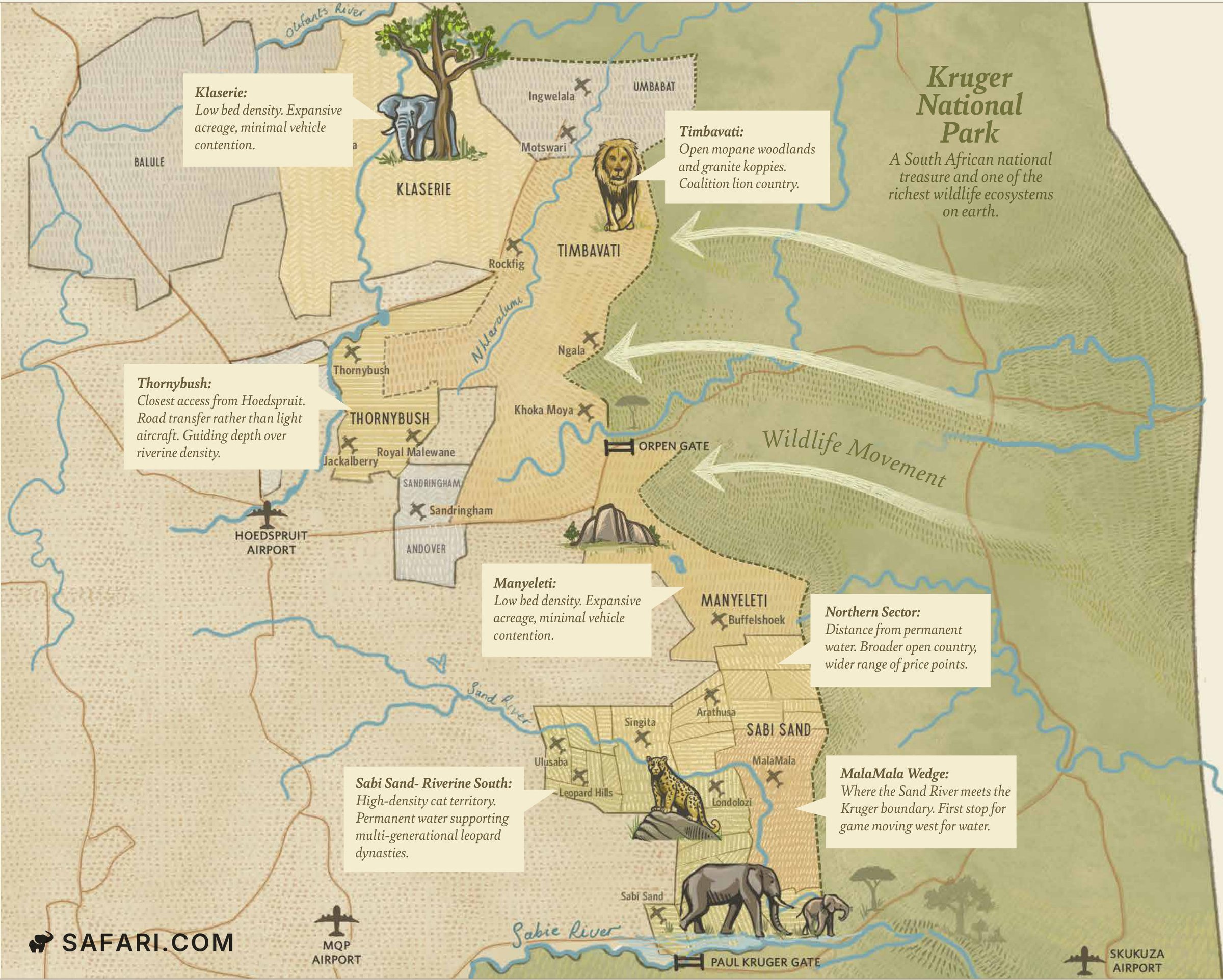
The Greater Kruger is South Africa’s Big Five heartland: the 4.8 million acres (1.9 million hectares) of Kruger National Park and, open to it on its western side with no fences between them, the private reserves of the Sabi Sand, MalaMala, Timbavati, Klaserie, Manyeleti and Thornybush. There is no wrong month to go. The useful question is what you want to see and how you want the days to feel, because that decides the season, and the season helps decide the ground.
There are two seasons. The dry winter runs from May to October: cold mornings, bare trees and short grass, and animals gathered on what water is left, which makes it the season for seeing the most game with the least effort. The green summer runs from November to April: hot days, afternoon thunderstorms, thick green bush and newborn animals. Both are good safari. This guide takes each season in turn, then the peak, shoulder and low months and what they cost, then the ground, then how the Kruger fits into a longer trip.
It is the companion to how to choose a safari lodge in Kruger and the Sabi Sand, which goes further into the where, and it sits inside our wider traveller’s guide to South Africa.
When to go: Kruger and the Sabi Sand at a glance
The Kruger and the Sabi Sand are a year-round safari, so choose your dates by what you want to see and experience. Go in the dry winter, May to October, if seeing as many animals as possible matters most and you do not mind cold mornings. Go in the green summer, November to April, if you prefer warm weather, green bush and young animals.
| If you want | Go in | Why |
|---|---|---|
| The most animals, most easily seen | June to October | Bare trees, short grass and game gathered at the water |
| Warm days and green bush | November to April | Summer heat, afternoon thunderstorms and the bush in full leaf |
| Baby animals | Mid-November to January | Impala lambs and wildebeest calves arrive from mid-November |
| Birds | November to March | The summer migrants are in residence |
| Leopard | Any month | Resident cats hold the riverine Sabi Sand all year |
| Walking safaris | May to August | Cool mornings and short grass |
| Lower rates | January to April | Low season at the lodges that price by season |
| Dry-season game below peak rates | May and October | The months either side of peak, when many lodges charge less than their top rate |
The dry winter: May to October
Choose the dry winter if seeing as much as possible is the point of the trip and you do not mind wrapping up. The rain stops, and as the winter goes on many of the trees drop their leaves, the grass dies back and the seasonal pans dry out. You can see further into the bush, and the animals concentrate along the permanent rivers and the pumped waterholes, where they are easier to find. Tracking becomes far more predictable: a good guide can put the vehicle on a route to water before the animals arrive, instead of following on behind them.
This is also when position counts for most. The Sand River runs for about 12 miles (20 km) through MalaMala, which holds both banks, before it crosses into the park, so game moving west out of Kruger in search of water reaches it first. In the Timbavati, the dry Nhlaralumi riverbed becomes a highway for lion, and its sand keeps a clean record of everything that walked it overnight.

What you trade is warmth and space. From June to August an early drive on an open vehicle can start in the low 40s°F (about 5°C) and warm to the upper 70s°F (about 26°C) by the afternoon, so pack a warm jacket, a hat and gloves. September and October stay dry but turn hot, and the first storms can arrive in October. The winter months are also the best known, so the rooms go first: July, August and September are the ones to book furthest ahead.
The green summer: November to April
Choose the green summer if you would rather be warm, and if you like the bush green, loud and full of young. About three-quarters of the year’s rain falls between November and March, mostly as afternoon thunderstorms that build and clear quickly, and within weeks the bush is in full leaf. There are plenty of animals, and they are in the best condition of the year. The impala drop their lambs from mid-November through December, the wildebeest calve in the same weeks and the warthog piglets are already about, which keeps the predators busy. The migrant birds are back, and photographers come for the clean light and green backdrops after a storm.

What you trade is ease. Midsummer days regularly pass 90°F (32°C), so drives start early and the middle of the day is for the pool. The long grass and thick leaf hide animals that would stand in the open in July, and with water everywhere the game spreads out, so a sighting can take more finding. The risk of malaria is highest in these wet months. The viewing that changes least is in the riverine south, where resident leopards keep the same territories all year, which makes the Sabi Sand and MalaMala the surest green-season choice for cats.
Peak, shoulder and low season: what each costs
Peak season in the Greater Kruger is June to September, plus the festive fortnight from about 20 December to early January. Low season is January to April. The shoulder months sit either side of peak. Each lodge draws the line itself: most that publish a shoulder rate apply it in October, and some in May or November, which other lodges price as low season.
| Season | Months | What it means |
|---|---|---|
| Peak | June to September | The highest rates and the fullest lodges. Book furthest ahead. |
| Festive peak | About 20 December to early January | Peak rates again, and at some lodges the highest of the year. |
| Shoulder | October most often, and May or November at some lodges | Rates between low and peak. The dates differ from lodge to lodge. |
| Low | January to April, and at many lodges May and November to mid-December | The lowest rates of the year, and the months with the most offers. |
Not every lodge prices by season. Of the Greater Kruger lodges whose full 2027 rates we hold, around six in ten publish a single rate for the year, some with a festive supplement. Among those that vary it, the published gap between low and peak is modest, usually between 7 and 15 per cent, as the 2027 rates of six lodges show.
| Lodge | Low season (late January) | Peak season (July) | Festive (late December) |
|---|---|---|---|
| Singita Ebony Lodge, Sabi Sand | ZAR 54,250 | ZAR 63,490 | ZAR 63,490 |
| Royal Malewane, Thornybush | ZAR 60,000 | ZAR 66,500 | ZAR 70,500 |
| MalaMala Camp | ZAR 30,550 | ZAR 32,850 | ZAR 32,850 |
| Lion Sands River Lodge, Sabi Sand | ZAR 28,570 | ZAR 32,420 | ZAR 32,420 |
| Simbavati Hilltop Lodge, Timbavati | ZAR 22,450 | ZAR 22,450 | ZAR 24,700 |
| Thornybush Game Lodge | ZAR 21,380 | ZAR 21,500 | ZAR 21,500 |
Published rates are only part of it, because the offers do more of the work. They are most common from January to March and again in November and early December, and scarcest from July to September. Simbavati Hilltop Lodge keeps one rate of ZAR 22,450 pps/night from January to October 2027, but from January to March it also has an offer rate of ZAR 16,830, a quarter less. From April to October there is no offer. If your dates are flexible, this is where a safari specialist earns their keep.
Where to go, and when each reserve is at its best
The private reserves fall into four landscapes, and the season affects each one differently. Kruger National Park itself is the fifth choice. All of them are open and worth visiting all year.
| Where | At its strongest | Best for |
|---|---|---|
| Riverine Sabi Sand and MalaMala | All year | Leopard in any month, and elephant on the Sand River in the dry months |
| Northern Sabi Sand | May to October | Value, with game concentrated on the waterholes |
| Timbavati, Klaserie and Manyeleti | May to October | Lion, walking safaris and space |
| Thornybush | All year | Easy access, families and shorter stays |
| Kruger National Park | May to October | The park by name, on a self-drive or from a private concession |
The riverine Sabi Sand and MalaMala
The Sand River runs through the middle of the Sabi Sand and the Sabie along its southern edge. Permanent water holds prey all year, and resident female leopards hold overlapping territories along it across generations, so this is the part of the system where the cat viewing changes least between seasons. The dry months add elephant: breeding herds come down to the river, and at MalaMala they cross it.
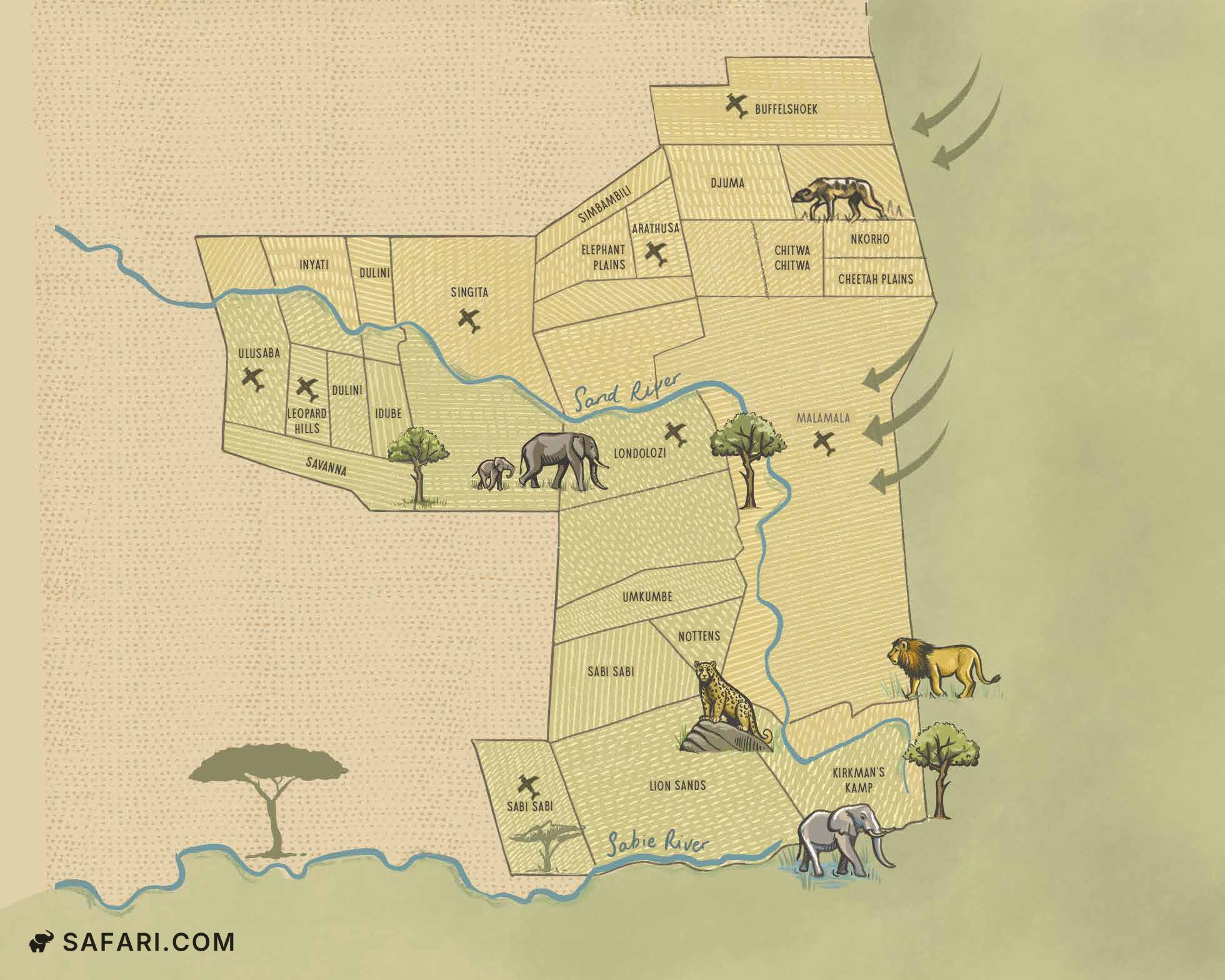
MalaMala Camp, on the Sand River, is from ZAR 27,600 pps/night. Lion Sands River Lodge, on the Sabie, is from ZAR 28,570 pps/night, and Singita Ebony Lodge, on the Sand River further west, from ZAR 51,660 pps/night.
The northern Sabi Sand
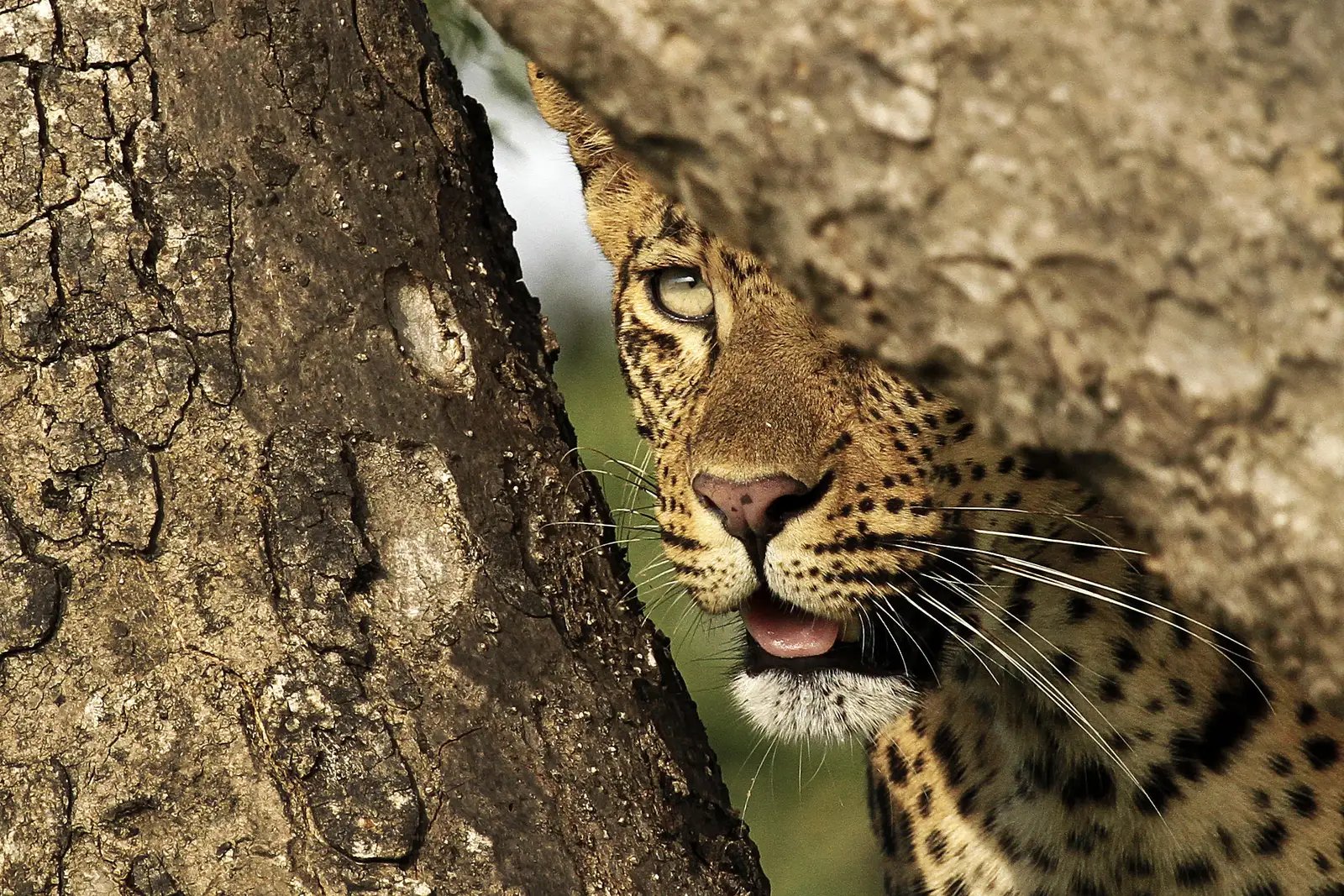
Away from the rivers the northern blocks open into broader country, and the viewing leans on waterholes. That works in a lodge’s favour in the dry months, when its waterhole may be the only water for miles, and matters less in midsummer, when there is water everywhere. The draw is price. Elephant Plains Game Lodge is from ZAR 7,300 pps/night, and Arathusa Safari Lodge, which overlooks a large waterhole, from ZAR 11,500 pps/night.
Timbavati, Klaserie and Manyeleti
The Timbavati and Manyeleti share a long unfenced boundary with the Orpen and Satara side of the park, Kruger’s lion country, and the Klaserie lies open to the Timbavati on its western side. Concessions run to tens of thousands of acres per lodge, and vehicle pressure is the lowest in the system. It is at its most distinctive in the dry months: the sandy riverbeds are at their best for tracking, the bush is open, and the cool mornings suit walking, which is concentrated up here.
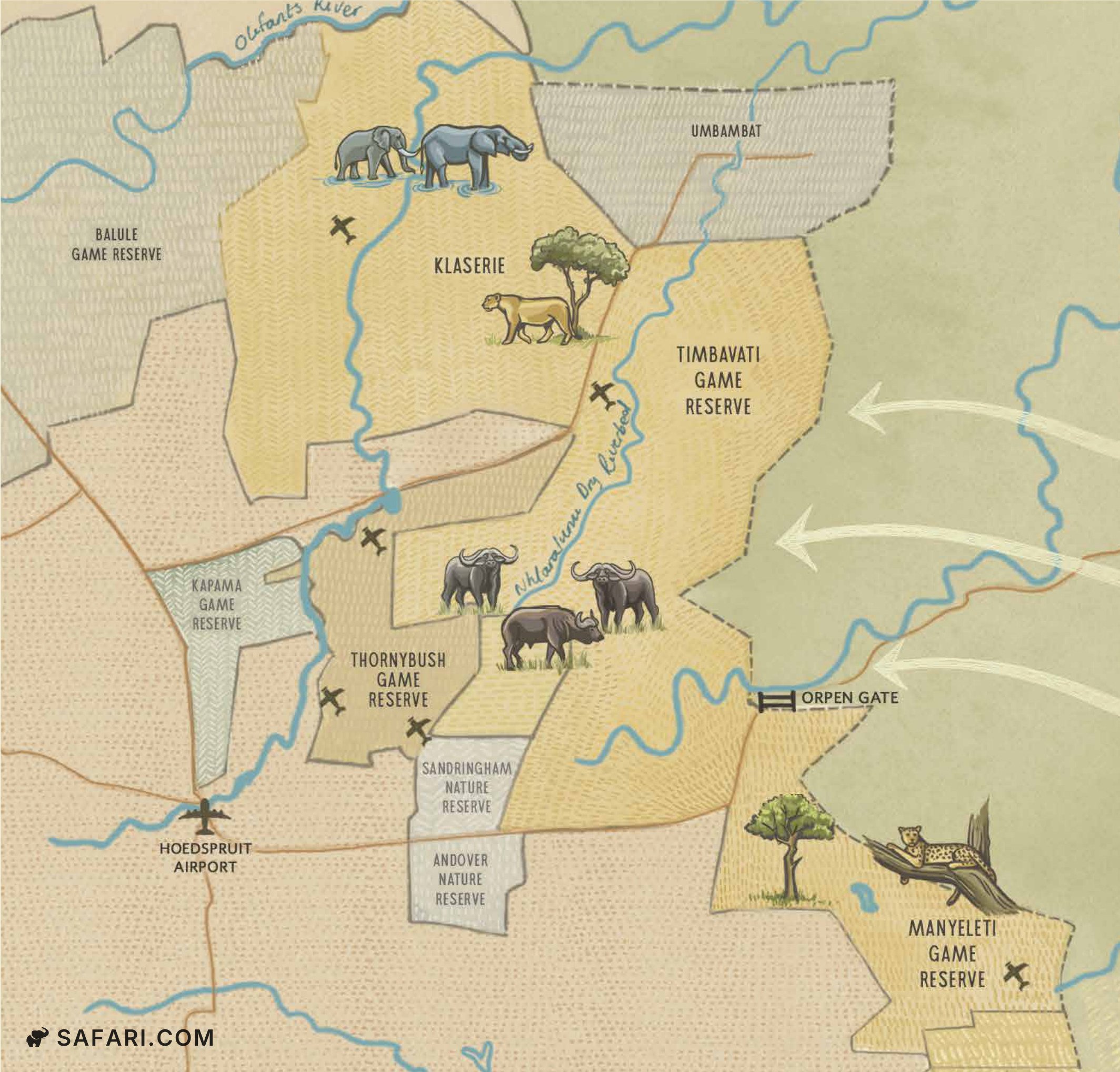
In the Timbavati, Simbavati Hilltop Lodge is from ZAR 20,400 pps/night, Kings Camp from ZAR 18,500 pps/night, and Tanda Tula Safari Camp, on the Nhlaralumi, from ZAR 31,500 pps/night. In the Klaserie, Africa on Foot is built around walking safaris, from ZAR 6,320 pps/night. The Klaserie also carries the Olifants River on its northern boundary, one of the region’s richest corridors for birds, at its best when the summer migrants are in.
Thornybush
Thornybush is a short road transfer from Hoedspruit’s airport, so you can arrive on a scheduled flight with normal airline luggage and no light aircraft leg. It has no park frontage and no perennial river, so the viewing is waterhole-driven, and its strengths are guiding and access in any month. For families, nervous flyers, or a two- or three-night Kruger leg inside a longer trip, it is the simplest answer. Thornybush Game Lodge is from ZAR 19,800 pps/night, and Royal Malewane, at the top of the reserve’s range, from ZAR 56,500 pps/night.
Kruger National Park itself
Inside the park, game viewing is from public roads within gate hours, with no limit on the number of vehicles at a sighting. It is the one part of the system you can do on a budget, on a self-drive between the rest camps, and the dry winter is when the thinner bush makes that most rewarding. The exception is a small number of private concessions inside the park, which run on private-reserve rules: Singita Lebombo Lodge is from ZAR 51,660 pps/night, and Hoyo Hoyo Safari Lodge from ZAR 10,490 pps/night.
How long to stay, and the case for a split stay
A week split between two reserves is the classic Greater Kruger itinerary: three or four nights in the riverine south for leopard and the river, then three or four in a northern reserve for open country, lion and walking. The reserves are a short flight or drive apart, and each half sharpens the other.
Our featured itinerary for November 2026 is a compact version of it: three nights at Simbavati Hilltop Lodge and three at MalaMala Camp, travelling in September, from US$11,523 per person including flights from Johannesburg and the transfer between the two.
One guest from Portugal booked a week across two reserves for August, at short notice:
“I made a reservation for a 7-night safari trip to two specific Private Game Reserves in the Kruger National Park in South Africa, for one of the busiest months in Kruger: August. This reservation was made at the last minute.”
Combining the Kruger with the rest of Southern Africa
Most guests do not come for the Kruger alone, and the season you choose for the bush sets the terms for everything else. Four combinations we plan often:
- Bush and city: Cape Town runs on the opposite clock, warm and dry from November to March. A green-season safari pairs with the Cape at its best, and a dry-season safari with a cooler, quieter Cape and the whale season from June to November. Our traveller’s guide to South Africa covers the regions.
- Bush and the falls: a short hop from the Kruger to Victoria Falls, which is fullest from about March to May.
- Bush and delta: the Okavango Delta is at its fullest from about May to August, and Chobe’s dry-season game viewing runs from May to October, the same months as the Kruger’s dry season, so the two combine naturally in winter. See our traveller’s guide to Botswana and when to travel the Southern Africa safari route.
- Bush and beach: a Greater Kruger safari followed by Mauritius or the Mozambique islands.
A guest from Ireland planned the Kruger, the falls and Chobe together for January:
“I had the pleasure of working with Lindi Weeks to plan a safari to Kruger National Park, Victoria Falls, and Chobe National Park in January, and I can't speak highly enough of her! She went above and beyond to help me plan my dream vacation, and provided detailed answers to the many questions I had.”
Travelling with children
Child policies vary more than any other rule in the Greater Kruger. Minimum ages for shared game drives run from none at all to sixteen, and some lodges take younger children only when the camp is booked exclusively. Our guide to child policies in the Kruger Park and Sabi Sands sets out the policy lodge by lodge. Season matters here too. The Greater Kruger is a malaria area, with the risk highest in the wet summer and lowest in the dry winter, so speak to your doctor about prophylaxis before you fix your dates.
Know before you go
A few practicalities worth knowing before you travel:
- Getting there: fly from Johannesburg or Cape Town to Skukuza for the Sabi Sand, to Hoedspruit for the Timbavati, Klaserie and Thornybush, or to Kruger Mpumalanga International near Nelspruit. From there it is a road transfer or a short light aircraft hop to the lodge airstrip.
- Luggage: light aircraft to the bush airstrips take soft-sided bags of up to 44 lb (20 kg) and no rigid suitcases. Scheduled flights to Skukuza, Hoedspruit and Kruger Mpumalanga carry normal airline limits.
- Storage: if you fly into the bush from Johannesburg with Federal Airlines, it will hold your excess luggage free of charge at its Johannesburg lounge, as long as you return the same way.
- Packing: neutral layers in khaki, olive and stone. Add a warm jacket, hat and gloves from June to August, and a light rain jacket from November to March.
Tell us the month you have in mind and who is travelling, and one of our safari specialists will tell you which ground suits it and what it costs in that season.
Written by Safari.com Editorial